April Bijou — In Conversation
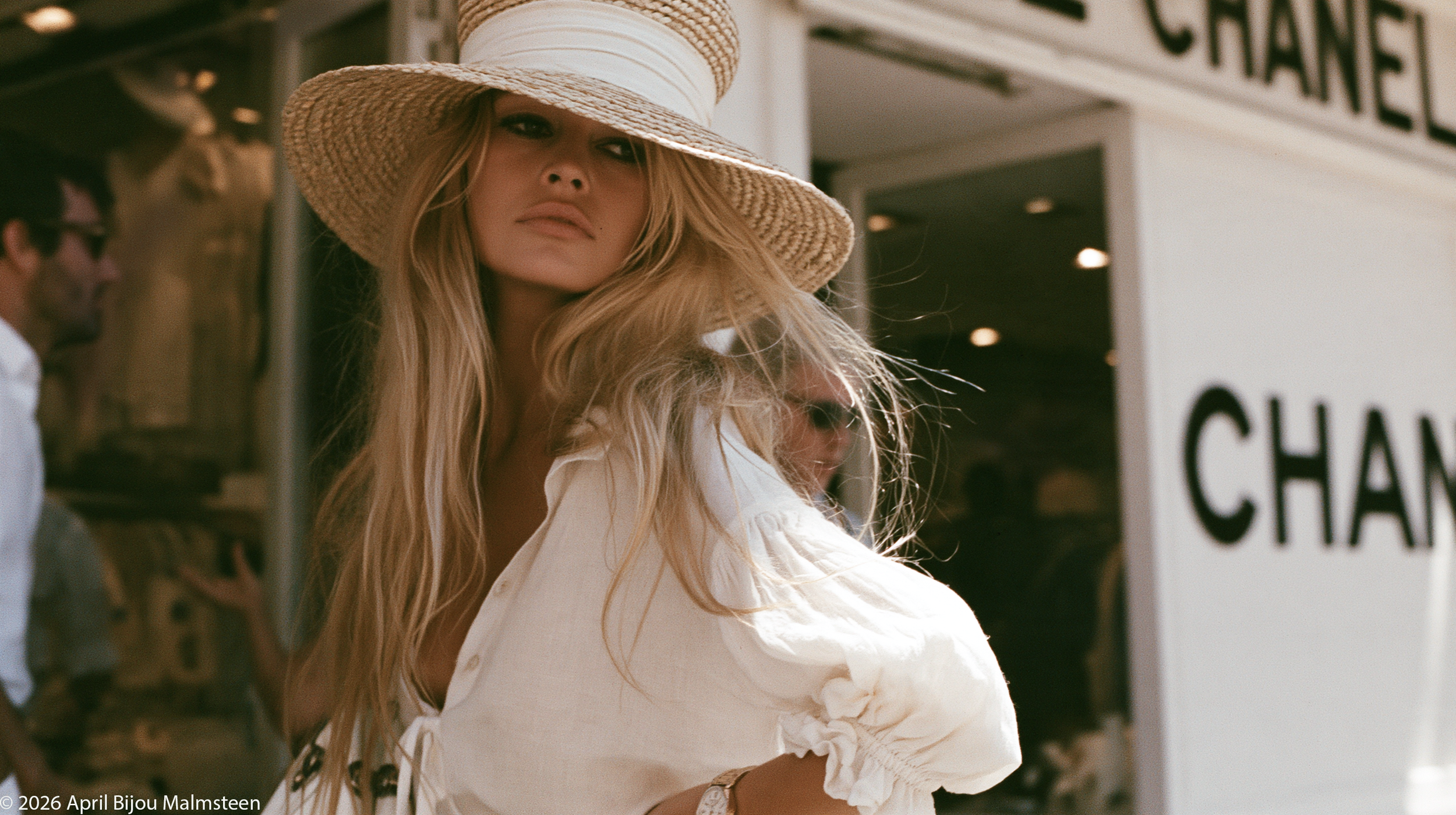
An intimate conversation with April Bijou Malmsteen on beauty, independence, imagination, and the art of living on one's own terms.
April Bijou Malmsteen has never been particularly interested in fitting into one description. An entrepreneur, author, model, and founder and creative director of Bonbon Avenue, she moves between storytelling, photography, fashion, and design with an instinctive sense of what belongs.
Here, she reflects on the things she values, the beauty of ordinary moments, and the quiet pleasure of making a life unmistakably her own.
Have you ever felt the need to choose just one creative identity?
Never. I think curiosity is too wonderful a thing to restrict. Writing, fashion, photography, and design might appear to be different worlds, but to me they're simply different ways of expressing the same ideas. I've never been interested in fitting neatly into a category.
What usually inspires you to create something?
Often something very small. The light in a room, an old photograph, a particular color, a memory of somewhere I've been. Sometimes the smallest detail becomes an entire idea. I love that. Inspiration doesn't always arrive with a grand announcement.
What was the original idea behind Bonbon Avenue?
I wanted to create beautiful things that women could actually live with. Things with personality, a little romance, and a sense of freedom. I love the idea of something accompanying you through life, rather than simply sitting beautifully on a shelf. There's a difference.
What distinguishes elegance from fashion?
Elegance has very little to do with being fashionable. It's knowing what suits you, what matters to you, and when to stop. You can feel it in someone's clothes, their home, even the way they speak. The most elegant things rarely need an explanation.
How do you define luxury today?
Time that belongs to you. Freedom. Privacy. The ability to enjoy something without feeling hurried. Luxury is the absence of urgency.
You've spoken about softness as a form of strength. What do you mean by that?
People sometimes mistake softness for permission. I don't see it that way. You can be gentle and have very firm boundaries. You can be kind without surrendering your judgment. Softness endures longer than force.
Your book, Whispers of the Dream Granter, inhabits a rather magical world. What interests you about writing for the imagination?
The possibility of telling a serious truth through something beautiful. I think children are far more perceptive than adults sometimes give them credit for. They understand longing, disappointment, courage, and consequence. Imagination gives us another language in which to explore those things.
Animals and the natural world seem to occupy an important place in your life. Why?
There's an honesty about animals that I find deeply comforting. They don't pretend to be anything other than what they are. They remind us that kindness is a responsibility, not simply a sentiment. Being around animals and nature has always brought me back to what matters.
What has experience taught you about being visible?
That being seen and being known are two very different things. A photograph captures a moment, not an entire person. I love photography and the beauty of an image, but I've never believed that being visible means giving away every part of yourself. Some things are more meaningful when they remain private.
What does an ordinary, beautiful day look like to you?
A quiet morning. Coffee. A good book. Time outside, perhaps tennis, perhaps a walk. Animals nearby. Something interesting to read or a beautiful old film to watch. I don't need every day to be extraordinary. There's an enormous pleasure in ordinary things when you have the time to notice them.
You're drawn to vintage cinema and the past. Are you nostalgic?
I adore old films, especially black-and-white cinema. The atmosphere, the dialogue, the clothes, the extraordinary attention to detail. But appreciating the past isn't the same as wanting to live in it. I love discovering what came before us. I'm equally interested in what hasn't happened yet.
Has your idea of success changed over time?
I think success becomes much more personal as you get older. It's less about how much you can do and more about whether what you're doing means something to you. I value independence, curiosity, and the freedom to make things with care. Those are wonderful measures of a life.
What are you most interested in creating next?
Things that surprise me. I hope I never lose that feeling of discovering an idea and wanting to see where it leads. I'm interested in doing things thoughtfully, without necessarily doing them loudly.
And what is the one thing you would never want to lose?
My ability to choose. What I create, how I spend my time, and what I keep for myself.
I think freedom begins there.