As Vogue / Le Monde Q&A
APRIL BIJOU — IN CONVERSATION
Creator or curator of a way of living?
I’m a creator first. The way of living comes as a consequence of making things honestly. I don’t set out to define a lifestyle, I follow the work, and the life arranges itself around it. I create because I must. The way of living follows naturally, barefoot, instinctive, a little defiant. I’ve never been interested in shaping an image. I shape a life, and people watch because it’s honest.
A smell that changed a moment—or a person?
Books. Salt air. A woman’s perfume lingering after she’s left a room.
Scent taught me that memory isn’t linear, it returns when it wants to, and sometimes it never leaves.
Did you always trust silence?
No. Silence used to feel like disappearance. Now it feels like authority. I learned that the most lasting things are rarely announced.
Which has been most misunderstood: beauty, power, or authorship?
Beauty. People mistake it for invitation when it is often a boundary. In my life, beauty has been a discipline, something to protect, not to trade.
Is softness a strategy or a truth?
It’s a truth that becomes a strategy only when the world underestimates it. Softness endures longer than force.
How do you define luxury when no one is watching?
Time. Autonomy. Silence. Luxury is the absence of urgency.
What did you have to unlearn to let beauty exist without explanation?
Gratitude. Beauty doesn’t require justification or apology.
Why is forward movement more radical than memory?
Because nostalgia can become a cage. The future asks more courage than remembrance.
When everything else is removed—what remains undeniably yours?
My attention. Where I place it, and where I refuse to.
Whispers of the Dream Granter your first book appears, on the surface, to be a whimsical fantasy, yet it carries a quiet gravity beneath its tenderness.What were you actually writing about when you wrote this book?
I was writing about choice, and about the cost of listening. Children’s stories are often dismissed as gentle, but they are where we first learn how the world treats longing. Whispers of the Dream Granter is not about wishes being granted; it’s about who we become when we’re asked to choose which parts of ourselves we’re willing to lose in order to belong. The village is soft because the truth it carries is not.
The book centers on Lily, a child who enters a world that seems to listen to her in ways the real world does not.Is this book a refuge, or a reckoning?
Both. A refuge is only meaningful if it shows you what you’ve been surviving. Lily is not escaping reality, she’s learning how to return to it intact. Fantasy exists to tell children what adults forget: imagination is not frivolous. It is preparation.
There is a recurring idea in the book that wishes are not free Why was it important to you that magic came with consequence?
Every wish carries a cost, whether we acknowledge it or not. I didn’t want to offer comfort without responsibility.
The characters of Bonbon Avenue are tender, eccentric, and deeply attentive. What do they represent?
They represent what happens when attention becomes an ethic.Each character listens, not to fix, not to correct, but to witness. I wanted to build a world where gentleness was not weakness, but structure. In many ways, the village behaves the way adults should.
You’re outspoken about protecting animals and natural worlds, yet you rarely frame this as activism. What draws you to that form of care?
I trust animals because they don’t negotiate their nature. They don’t perform innocence, and they don’t ask to be forgiven for existing. Caring for them isn’t sentimental for me, it’s corrective. Nature doesn’t need our interpretation. It needs our restraint.
What is the most beautiful day?
Today.
The easiest mistake you can admit to?
Being wrong.
The biggest obstacle?
Fear.
The biggest mistake?
Giving up.
The biggest character flaw in humans?
Selfishness.
The greatest work ethic?
A positive outlook and determination.
The hardest climb?
Living without hope.
What truly makes you happy?
Being of service to others. Caring for animals. Protecting what cannot protect itself.
You’ve reached a moment where your voice feels fully formed. What does the next chapter look like for you — creatively, personally, or philosophically?
The next chapter feels less like expansion and more like deepening. I’m interested in doing fewer things, but doing them with greater care. Creatively, that means returning to what feels essential, stories that linger, work that breathes. Personally, it means living with more presence and less negotiation.
In your life, what are you more interested in building, legacy, freedom, or intimacy with your work?
Freedom first. From that, intimacy follows naturally. Legacy is something others decide later.
Is there something you’re moving toward quietly that you haven’t named publicly yet?
Yes, but I’ve learned not to rush naming things. Some ideas need silence to mature. I trust that when it’s ready, it will arrive without effort.
Away from the work, how do you spend your time when no one is asking anything of you?
I read. I walk. I play tennis, I spend time with animals, family and nature. I enjoy vintage movies, unhurried conversations, and quiet mornings. I don’t confuse fullness with busyness.
What kinds of rituals or habits keep you grounded when life becomes demanding?
Being outside, nature. Touching something real, earth, water, fur, trees, grass, flowers all of god’s codes. Returning to simple rhythms reminds me what actually matters.
You speak often about attention and care. What activities allow you to feel most present?
Listening. Whether it’s to a person, an animal, nature, music, inner voice or a place, listening anchors me. It slows everything down in the best way.
What draws you to animals and nature, and how do they shape the way you move through the world?
Animals don’t pretend. They don’t perform. Being around them teaches humility and responsibility. Nature reminds me that life doesn’t need to be managed, only respected.
Are there simple pleasures you protect fiercely reading, walking, solitude that feel essential rather than indulgent?
Yes. Solitude, especially. Not isolation, solitude. It’s where clarity returns.
After such an intense professional life, what draws you now toward quieter worlds?
Balance. After years of movement, schedules, and constant decision-making, there’s something deeply restorative about continuity, returning to the same places, the same rhythms. Sunlight, sea air, trees, the sound of birds , these are not escapes for me. They’re reminders of proportion.
How do those environments influence your creative life?
They slow me down in the right way.
Nature has its own intelligence, it doesn’t rush, but it also doesn’t hesitate. Being around it recalibrates how I think, how I write, how I listen.
Your work often feels attentive rather than urgent. Is that intentional?
Yes. Attention changes the quality of what you make. When you’re no longer reacting, you begin to notice subtleties, tone, texture, silence. That’s where meaning usually lives.
You’re often associated with literature and storytelling, but people are rarely just one thing. What are a few things people might not realize you’re particularly good at, and what occupies your curiosity beyond the work?
I have a long-standing relationship with observation.
I love vintage cinema, especially black-and-white films, and I’m deeply interested in history and philosophy. Those worlds train the eye and the mind in patience, which influences everything else I do.
Photography has always been part of my life, particularly black-and-white photography. I take many photographs that never carry my name, some of them far more visible than people realize. I’ve never felt the need to claim them publicly. The act of seeing has always mattered more to me than attribution. Design, fashion, and visual composition are also second languages for me. I think in images as much as I do in words, and creativity tends to move fluidly between those forms. I’ve learned that some of the most meaningful work happens quietly, when it’s allowed to exist without explanation.
As Vogue / Le Monde Q&A
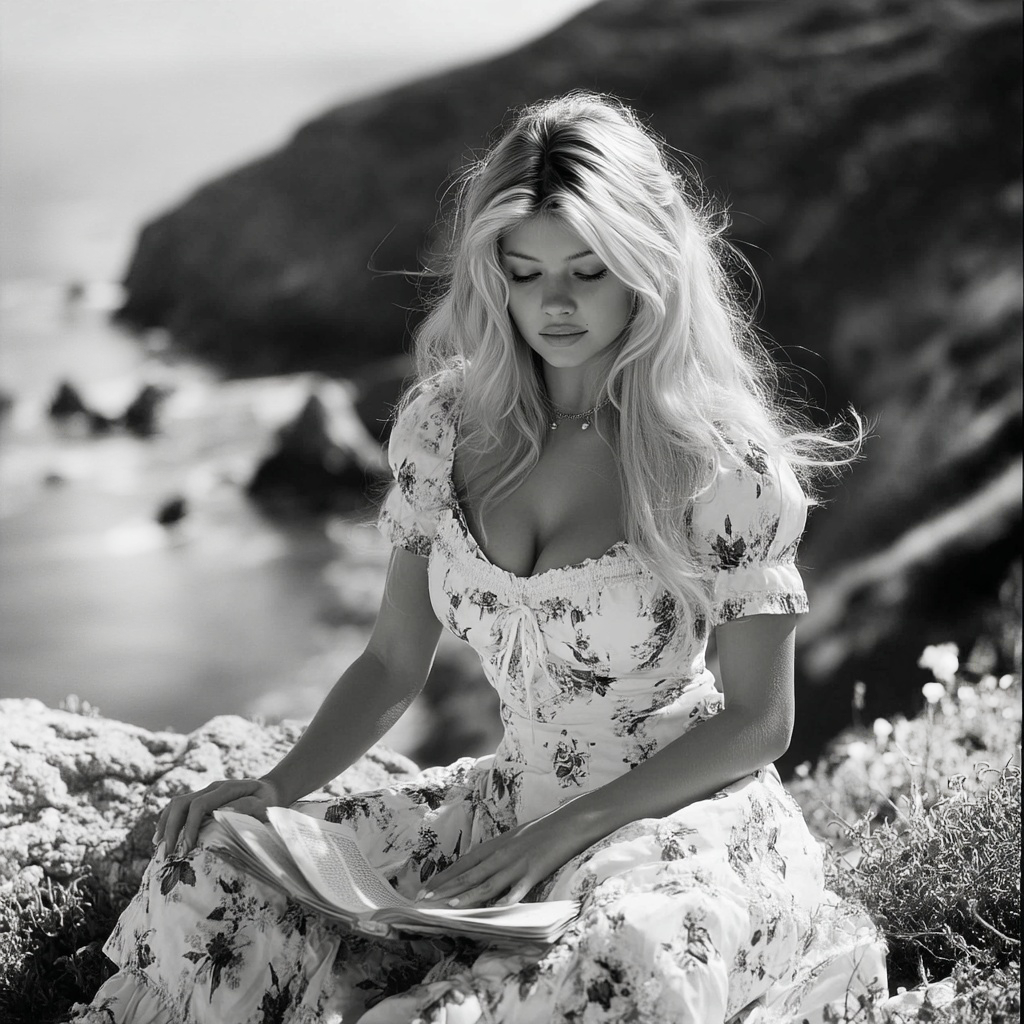
April Bijou Malmsteen